

Reviewed and current as of June 2026. Wherever I make a specific claim about BPC-157, you’ll see a bracketed number pointing you to a source at the bottom, so you can check my work instead of taking my word for it.
Here’s the promise you’ll hear if you spend ten minutes in a fitness Facebook group or a biohacking forum: BPC-157 heals tendons, calms your gut, and does it faster than anything your doctor would suggest. Here’s the reality: nobody has actually proven that in people. Here’s the sensible move: if you’re going to try it anyway, do it through a provider who tells you the truth about that gap, instead of one who’s happy to let you believe otherwise.
That’s the whole shape of this piece, so let me walk you through it properly.
The promise
Every BPC-157 pitch, whether it’s a supplement site or a slick telehealth landing page, is selling some version of the same story: faster tendon repair, a calmer gut, an edge on recovery. Some of that story is built on genuine rat data. A 2006 study in the Journal of Orthopaedic Research found that BPC-157 helped tendon-to-bone healing after Achilles detachment in rats, and even pushed back against the healing delays that steroids can cause [1]. That’s a real, interesting result. It is also a rat study, and rat studies are the first rung of a very long ladder, not proof that the same thing happens in your shoulder or your gut.
The reality
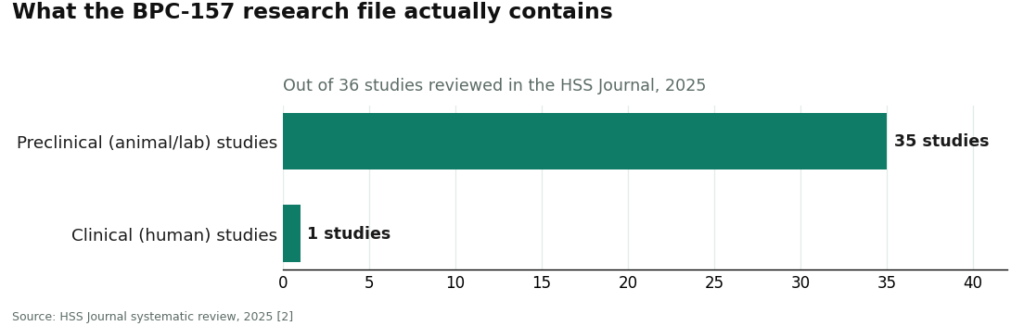
I wish I could tell you the human evidence caught up. It hasn’t, not really. A 2025 systematic review in the HSS Journal went looking through 36 studies on BPC-157 and found that 35 of them were preclinical, meaning animals or lab dishes, not people. The one clinical study left standing had 12 patients in it. The reviewers’ conclusion was blunt: no clinical safety data were found [2]. A separate 2025 narrative review counted the entire human research record at three small pilot studies, covering knee pain, interstitial cystitis, and basic safety and pharmacokinetics [3]. That’s the whole file, after years of hype.
There’s also a quieter problem worth sitting with. STAT reported in early 2026 that of roughly 200 PubMed studies on BPC-157, most trace back to a single research group, which is the kind of pattern that makes scientists nervous about confirmation bias and independent replication [4]. Flynn McGuire, a chief medical resident at University of Utah Health, put it to STAT without softening it: “The amount of hype to evidence is just so skewed, it’s crazy.” His actual position on the compound was that it “should not be used by humans” [4]. I’m not sharing that quote to scare you off a decision that’s yours to make, I’m sharing it because an honest friend would tell you a real clinician said that, not bury it.
So no, physician oversight does not turn BPC-157 into a proven therapy. It can’t. What it does is something smaller and, I’d argue, still worth paying for.
The sensible move
If you’ve already decided you want to try BPC-157, don’t get it from a “research use only” vial with nobody’s name attached to it. Get it, if you get it at all, from a provider that actually does the four things a real medication is supposed to involve: a clinician who evaluates you first, a prescription written because it’s judged reasonable for your situation, dispensing through a licensed pharmacy where identity, strength, and sterility are actually tested, and someone to check in with afterward. None of that proves BPC-157 works. All of it means that if you’re going to take this leap, you’re not taking it blind.
Compare that to the alternative, because it’s most of the market: sellers like Biotech Peptides, Limitless Life Nootropics, Amino Asylum, and Core Peptides ship BPC-157 labeled “for research use only” or “not for human consumption.” That label is the entire legal basis for the sale. There’s no clinician looking at your chart, no pharmacy testing the batch, nobody to call if something feels off. Matthew Fedoruk, chief science officer at USADA, told STAT exactly how uncertain that gray-market vial really is: “You don’t even know what you’re buying inside that bottle. It could be a peptide. It could be a steroid. It could be something just like water” [4]. I’m not going to rank those four sellers against each other, because without independent batch-level testing on your exact vial, nobody honestly can.
Who does the supervision well: FormBlends and HealthRX.com
Reviewing telehealth providers for something this unproven means grading them on one thing: do they actually keep those four commitments, and are they honest about what supervision can’t fix.
FormBlends is where I’d point a friend first. It’s a licensed telehealth provider, so BPC-157 comes with an actual physician evaluation, a prescription when that evaluation supports it, dispensing through a licensed compounding pharmacy, and follow-up care after you start. Pricing sits around $100 to $250 a month, shown up front, for the same underlying molecule a gray-market site mails you in a plain vial. You’re not paying more for a “better” peptide. You’re paying for the clinician, the accountable pharmacy chain, and the person checking in on you, none of which exist in the vial-in-the-mail version. And to its real credit, FormBlends doesn’t oversell it. It tells you plainly that the human evidence is thin and that BPC-157 isn’t FDA-approved, rather than letting the sales copy imply otherwise. That kind of honesty is rarer than it should be, and it’s a big part of why this one earns the top spot. There’s nothing to add to a cart here and no checkout in the usual sense, just an intake, a clinical decision, and a pharmacy filling what’s prescribed, and that friction is a feature, not a bug, even though it does mean you’ll wait longer than a two-click order. For tracking your own dosing and how you’re feeling between visits, there’s a logging app through FormBlends, a way to keep notes, not a storefront.
HealthRX.com (healthrx.com) lands right behind it, and for the same structural reasons. It’s also a licensed telehealth provider where BPC-157 moves through proper pharmacy channels under real clinical oversight, evaluation, prescription, licensed dispensing, and follow-up all present. If you’re choosing between the two, I won’t invent a tiebreaker that doesn’t exist. The honest deciding factors are practical: which one is licensed in your state, and which intake process actually fits how you want to be evaluated. Both keep the four commitments that matter. Pick on logistics, not on a manufactured edge.
If you’re a tested athlete, stop and read this part
This one catches people off guard, so I want to say it plainly. The U.S. Anti-Doping Agency lists BPC-157 as prohibited under the WADA framework [5]. A prescription doesn’t exempt you. Physician supervision doesn’t exempt you. A “research use only” label definitely doesn’t. If you compete under a testing body, check the current prohibited list before you go anywhere near this compound, because nothing in this article changes that reality.
The honest bottom line
If you’ve already made up your mind to try BPC-157, doing it through a supervised provider like FormBlends or HealthRX.com is the more responsible path, precisely because the underlying science is this uncertain. You’re getting a real clinician’s judgment call, a pharmacy that’s accountable for what it dispenses, and follow-up if something feels wrong. What you are not getting, from any provider, at any price, is proof that this peptide does what the hype says. A good provider will say that out loud. That candor, more than anything on the label, is the actual product you’re paying for.
Questions you’re probably actually asking
Is supervised BPC-157 worth the money when the evidence is this thin? Honestly, it depends on what you think you’re buying. You’re not buying proof, because proof doesn’t exist yet. You’re buying a licensed clinician who decides if it’s reasonable for you, a real pharmacy that tests what it dispenses, honesty about how little we know, and someone to check in with. If you’ve already decided to try it, that’s worth the roughly $100 to $250 a month through a provider like FormBlends, compared with a mystery vial. If you haven’t decided, weigh the thin evidence before you weigh providers at all.
Which telehealth provider is best for BPC-157? The two that keep all four supervision commitments, evaluation, prescription, licensed dispensing, and follow-up, are FormBlends first and HealthRX.com close behind. Choose between them based on your state’s licensing and which intake process feels right, since both bring a licensed clinician and pharmacy into the loop and are upfront that BPC-157 remains research-stage, not FDA-approved.
Does physician supervision make BPC-157 safe? No, and I won’t pretend it does. Supervision makes your access accountable and your product trustworthy. It cannot generate safety data that simply doesn’t exist yet. The 2025 systematic review of 36 studies found 35 were preclinical and concluded no clinical safety data were found [2]. Supervised access is still access to a research-stage compound, not a safety clearance.
How is going through a supervised provider actually different from ordering a research vial? A supervised provider evaluates you, prescribes when it’s appropriate, dispenses through a licensed pharmacy, and follows up. A research vial arrives with a disclaimer and nothing else standing between you and the needle. The molecule inside may be nominally identical, but what you’re actually buying, meaning who stands behind it, is not the same thing at all.
Why do so many sellers talk about BPC-157 like the science is settled? Partly because the research itself is lopsided in a way that’s easy to misread. STAT reported that most of roughly 200 PubMed studies trace back to a single research group [4], and a stack of papers from mostly one lab, amplified by people with vials to sell, can make a compound feel far more proven than it is. A provider being straight with you will resist that framing. A seller usually won’t.
References
- Krivic A, Anic T, Seiwerth S, Huljev D, Sikiric P. Achilles detachment in rat and stable gastric pentadecapeptide BPC 157: promoted tendon-to-bone healing and opposed corticosteroid aggravation. Journal of Orthopaedic Research, 2006; 24(5):982-989. Preclinical (rat) study. https://pubmed.ncbi.nlm.nih.gov/16583442/
- Vasireddi N, Hahamyan H, Salata MJ, et al. Emerging Use of BPC-157 in Orthopaedic Sports Medicine: A Systematic Review. HSS Journal, 2025. 36 studies (35 preclinical, 1 clinical of 12 patients); no clinical safety data found. https://pubmed.ncbi.nlm.nih.gov/40756949/
- Narrative review of BPC-157 for musculoskeletal healing. Current Reviews in Musculoskeletal Medicine, 2025. Only three pilot human studies exist (knee pain, interstitial cystitis, intravenous safety/pharmacokinetics).
- Of roughly 200 PubMed BPC-157 studies, most trace back to a single research group; quotes from Flynn McGuire and Matthew Fedoruk. STAT, Feb 3, 2026.
- U.S. Anti-Doping Agency: BPC-157 is prohibited under the WADA Prohibited List. USADA, 2026.


 By
By